
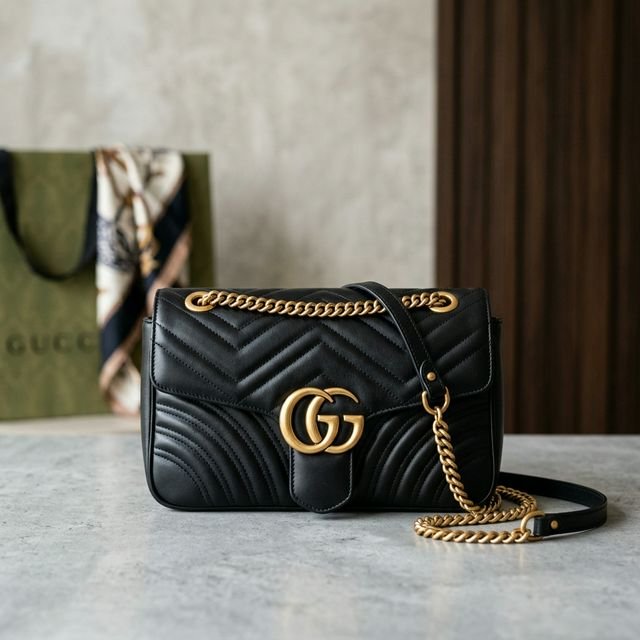
When Alessandro Michele arrived at Gucci in 2015, the house had been many things: the epitome of jet-set glamour in the 1970s, a byword for flashy excess in the 1990s, a reformed luxury powerhouse under Tom Ford and Frida Giannini. What it had never been, quite, was this — maximalist, nostalgic, deeply intellectual, wrapped in an aesthetic that looked backward and forward simultaneously. Michele’s Gucci was a new thing entirely. And the GG Marmont, introduced under his tenure, became its most eloquent symbol.
The Marmont’s DNA
The GG Marmont takes its name from the Hôtel de la Paix Marmont in Los Angeles — a place layered with Hollywood mythology. Its chevron-quilted velvet surface references the house’s 1970s archive, while the oversized Double G logo in antique gold hardware reads as simultaneously vintage and aggressively contemporary. The bag works as a shoulder bag, a crossbody, a camera bag, and a belt bag — its versatility one of the defining features of Michele’s tenure: luxury that moves with real life.
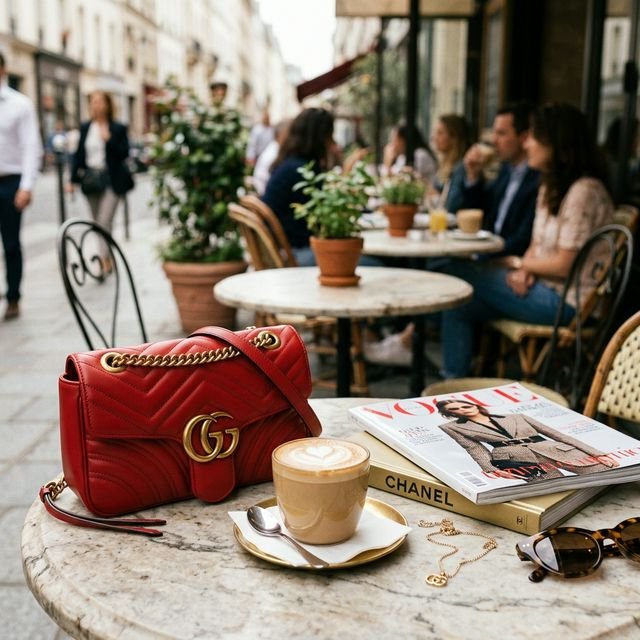
The Marmont is made in Italy, in workshops that combine artisanal techniques with contemporary precision manufacturing. The chevron quilting is executed by machines calibrated to tolerances of a fraction of a millimetre, but the finishing — the edge painting, the hardware fitting, the quality control — remains stubbornly human. Each bag passes through twelve pairs of hands before it leaves the workshop. This is not efficiency. It is thoroughness.
The House That Reinvented Itself
Under Michele and now under his successor, Sabato De Sarno, Gucci’s ready-to-wear has undergone equally dramatic shifts. De Sarno’s debut collection — shown in Florence in September 2023 — was a studied corrective to Michele’s exuberance: quieter, more minimal, draped in a signature deep red that has since been named “Ancora.” Where Michele spoke in exclamation marks, De Sarno speaks in considered sentences. Both approaches are entirely, recognisably Gucci.
“I want to create something that allows each person to feel free, unique, and completely themselves.” — Alessandro Michele
What both directors understand is the house’s greatest asset: its absolute self-confidence. Gucci has never pretended to be understated. It has always known what it was — Italian, theatrical, slightly outrageous, deeply joyful — and it has never apologised for any of it. That consistency of spirit, across wildly different aesthetic languages, is the true Gucci legacy.
The GG Marmont endures because it captures this spirit perfectly. It is a bag that is instantly recognisable yet deeply personal — a bag that announces its owner as someone who values beauty, history, and the particular pleasure of carrying something made with genuine love. That, ultimately, is what all great Gucci objects share. Not perfection. Joy.
Discussion