
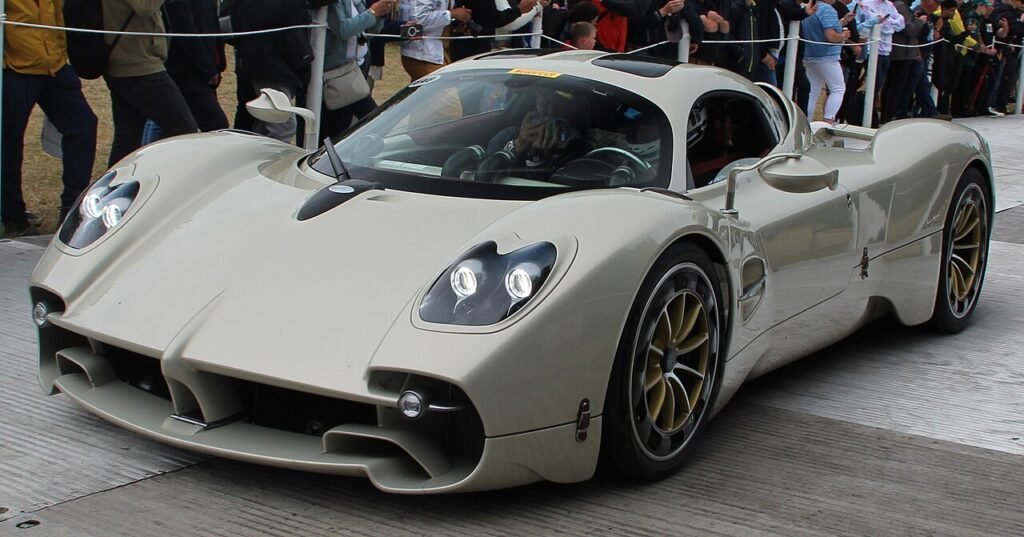
In the radiant dawn of Modena, Italy, where the air seems to vibrate with the echoes of racing legends, the Pagani atelier stands as a cathedral of modern craftsmanship. The Pagani Utopia is not merely the third act following the Zonda and Huayra; it is a profound declaration of mechanical independence. Horacio Pagani, through six years of relentless obsession, has achieved a near-impossible equilibrium: marrying cutting-edge aerospace materials with the timeless aesthetics of the Da Vinci era. The result is a machine that appears nearly static in its grace, yet roars with a primordial soul.
The Renaissance Aesthetic: Beyond Mere Elegance
The design language of the Utopia deliberately turns its back on the aggressive, fragmented geometries that have become shorthand for modern hypercars. Instead, it embraces a more poetic, fluid sense of “timeless beauty.” Its rounded, muscular contours evoke memories of 1950s racing icons at Le Mans. There are no garish active wings to disrupt the silhouette; instead, Pagani has integrated a sophisticated underbody airflow system to achieve aerodynamic balance. The chassis, crafted from Pagani’s patented Carbo-Titanium HP62 G2 and Carbo-Triax HP62, offers a level of rigidity found in secret aerospace programs, yet keeps the total weight to a staggering 1,280 kg—giving this beast the reflexes of an apex predator.

An Ode to the V12: The Final Stand of the Machine
While the rest of the automotive world prepares for the funeral of the internal combustion engine, Pagani remains steadfast. He has commissioned a bespoke 6.0-liter twin-turbo V12 from Mercedes-AMG, a jewel of an engine that produces 864 horsepower. But the magic lies not in the numbers, but in the delivery: 1,100 Nm of torque available from just 2,800 rpm. In a move that has purest drivers rejoicing, the Utopia offers a seven-speed manual transmission. When you grasp that exposed shifter mechanism and hear the V12 bark to life, you realize this isn’t just transport; it’s an interactive symphony of fire and steel.
The Essence of Luxury: Finding the Soul in the Millimeters
Stepping into the Utopia’s cabin is like entering the heart of a grand complication watch. Digital interfaces are banished, replaced by mechanical dials, ruby bearings, and toggle switches with precise, weighted damping. Every screw and every inch of top-tier leather is hand-finished by artisans who spend thousands of hours on a single vehicle. For Pagani, luxury isn’t an expensive label; it is the tangible manifestation of human patience and intellect. In a disposable world, the Utopia stands as a sacred monument to the enduring beauty of the machine. This is more than a car; it is a visual manifesto written in carbon and gasoline.


Discussion