
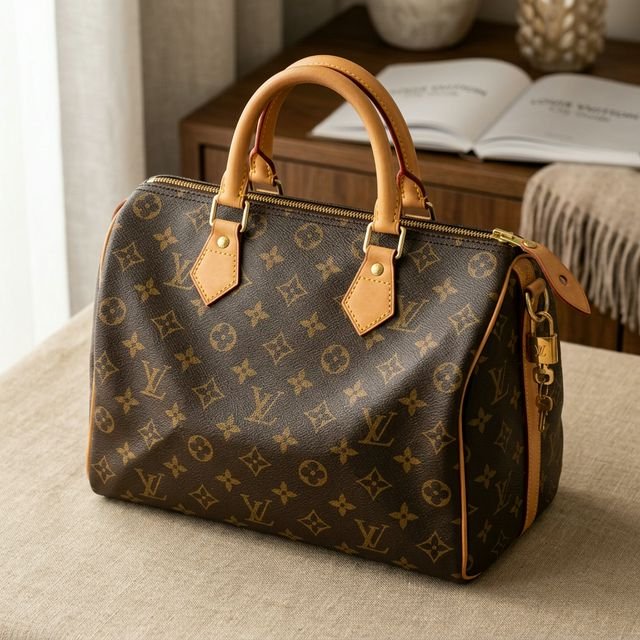
Louis Vuitton did not invent the trunk. But in 1854, he perfected it — and in doing so, he invented modern luggage, modern luxury travel, and the foundations of what would become the world’s most valuable fashion brand. The Monogram canvas, introduced in 1896 by his son Georges as an anti-counterfeiting measure, has since become the most recognised surface treatment in the history of fashion. It is, by most measures, the most copied design in the world — which is, paradoxically, the greatest compliment of all.
The Grammar of the Monogram
The LV Monogram is not simply a logo placed on a surface. It is a complete, self-contained graphic language — the interlocking LV initials, the four-petalled flower, the diamond with a curved four-pointed star — each element derived from the Japanese and Oriental design trends popular in late 19th-century Europe. The pattern tiles seamlessly: no element is ever cut at a seam. Achieving this in the manufacture of three-dimensional bags requires extraordinary precision in the cutting and assembly process.
The canvas itself is not leather — it is a coated cotton, developed to be both lighter and more durable than the water-resistant grey Trianon canvas it replaced. This practicality was always at the heart of the Vuitton project: these were bags designed to travel, to be stacked in ship holds and railway luggage racks, to endure decades of use. The Keepall holdall, introduced in 1930, can be rolled into itself for packing. The Speedy — originally made for tennis — weighs almost nothing. Function has always come first.
Nicolas Ghesquière and the New Chapter
Under creative director Nicolas Ghesquière, Louis Vuitton women’s ready-to-wear has undergone a remarkable transformation. Where the house once leaned heavily on its heritage narrative, Ghesquière — a master of architectural clothing and precise historical reference — has pushed it firmly into the future. His collections layer references from the 1960s space age, the 1980s power suit era, and the far future simultaneously, creating clothes that feel genuinely original.
“To travel is to live a thousand lives.” — Louis Vuitton brand ethos, 1854
The Capucines, introduced in 2013, represents this new chapter in hardware form: a structured top-handle bag named after the boulevard where the first LV store opened in Paris, it eschews the Monogram entirely in favour of fine smooth leather and subtle LV initials on the clasp. It is the quiet counterpoint to the canvas — proof that the house can speak in whispers as powerfully as it can in its iconic graphic shout.
Over 170 years after Louis Vuitton first opened his trunk-making workshop in Paris, the brand he created continues to define what luxury travel — and luxury itself — means. Its trunks still travel to the moon (NASA uses Vuitton cases). Its bags queue outside boutiques at dawn. Its name is the first word in luxury, the standard against which every other house measures itself. Some legacies are not built. They accumulate.